Why HR Leaders Need Endurance, Not Just Resilience
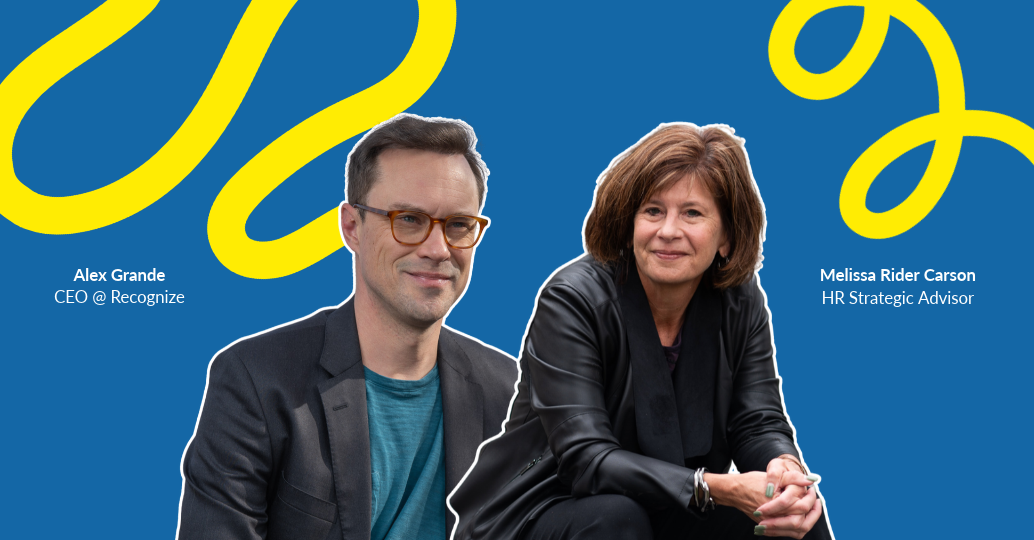
Speakers
Watch the Recording
Watch Now →About This Session
If you’re an HR leader with a team, you’re often playing three roles at once. Melissa Carson looks at it with an endurance sports lens: You’re an athlete, doing the work. You’re the coach of other athletes, developing your team. And you’re the coach’s coach, the person coaching all the other coaches and the one everyone calls when it gets messy. So who’s coaching and supporting you?
Grab a coffee and join Recognize CEO Alex Grande for an honest conversation with Melissa Rider Carson, a strategic advisor and former senior HR leader with more than 20 years combined at Accenture and EPAM. Melissa holds SHRM-SCP and SPHR credentials and is an ICF Professional Certified Coach. They’ll dig into why bouncing back isn’t enough, what an endurance foundation looks like for the people who hold everyone up, and how to make good calls when you’re stretched thin.
We’ll talk about:
⭐️ What each role asks of you, and why carrying all three is challenging
⭐️ Why resilience isn’t the solution and why a focus on endurance is a better strategy
⭐️ The risks of making big decisions when you’re tired, busy, and pulled in every direction, and three questions that can help
⭐️ Why support and recognition can’t all run through you, and what to build instead
⭐️ What to start or stop before 2027 to build up your endurance foundations
Speakers & Hosts
Meet the people leading this session. Full bios and titles are shown below.
CEO and Co-Founder, Recognize
Alex Grande is a web developer with a passion for motivation and human behavior. Alex has spent over a decade engineering the "Human API", using technology to scale the fundamental psychological need for appreciation.
Strategic Advisor
Melissa Rider Carson is a strategic advisor, executive coach, and speaker with 30+ years of experience in leadership, organizational effectiveness, and business strategy. She helps leaders navigate complexity and build organizations that thrive through growth, pressure, and change. Her work focuses on Leadership & Organizational Endurance.
Transcript
Summary: Most HR conversations focus on how HR leaders can help other people. This one is about how they can help themselves. Alex Grande, co-founder and CEO of the employee recognition and rewards platform Recognize, talks with executive coach Melissa Rider Carson about building the foundation to perform day after day, making better decisions under pressure, working in the age of AI, and who supports the people who support everyone else.
About Melissa Rider Carson: Melissa brings 30 years of experience across leadership, organizational effectiveness, people strategy, and business strategy, including 20 years at Accenture and EPAM. She is a strategic advisor to CEOs, founders, senior executives, and leadership teams, helping them make sense of recurring people, leadership, team, and organizational problems, challenge assumptions about what causes them, and make stronger decisions about what to do next. As an author, she writes about leadership and organizational endurance: the capacity to keep making sound decisions and build organizations that operate effectively through pressure, growth, and change. Her speaking sessions include The Leadership Endurance Challenge and Why Growth Exposes the Cracks.
An endurance story
Alex Grande: You run marathons, half marathons, Ragnar relays, and triathlons. What’s a memorable experience you’d like to share?
Melissa Rider Carson: There have been so many. Speaking of endurance, in 2018 I decided to train for my first marathon, something I said I would never, ever do. Less than half a mile into my 20-mile training run, I tripped and fell, ended up with a freak injury, and the marathon didn’t happen that year. Recovery took a while.
In 2020, a similar group of women was training for the virtual Marine Corps Marathon, and that was my chance to get back in. I ran it alongside about 20 to 30 women, virtually. Then in 2023 I ran it for real, on the actual course. So it was a journey of enduring to get to the real Marine Corps Marathon.
Alex Grande: I didn’t know virtual marathons existed.
Melissa Rider Carson: Only because of COVID. People were already registered, so the organizers honored that. You logged your time, sent it in, and they mailed you the medal.
The athlete, the coach, and the coach’s coach
Alex Grande: HR leaders often play three roles: the athlete, the coach, and the coach’s coach. The athlete is an individual contributor, the coach is a manager, and the coach’s coach is a mentor. Walk us through each one. Where should leaders focus more attention?
Melissa Rider Carson: Everyone shows up at work every day in athlete mode, which means we all need to lead ourselves well. Every person on this call has that job.
Those of us with teams are also coaches. How do I set my team up for success? Are they in the right roles? How do I coach them to high performance?
HR leaders often wear a third hat: coaching the other coaches so they can succeed. A lot of people in HR are givers who want to care for others, so that third hat ends up carrying a lot of weight, and the athlete hat, taking care of yourself, often takes a back seat.
Alex Grande: What are some tangible things people can do to strengthen that?
Melissa Rider Carson: It starts with believing you’re a priority. Think of the oxygen mask on a plane. To lead our teams and other leaders well, we have to show up at our best. I think of every day as a start line for a race with no real finish. If we have to show up fresh every day to run the distance in front of us, we need to do the things that matter most.
I know from experience it isn’t easy to prioritize sleep, moving your body, and time to reflect. But we’re all better leaders when we recognize that those things make us better performers. We can serve more people when we care for ourselves.
Alex Grande: What do you do for yourself?
Melissa Rider Carson: I make sure I have some quiet time in the morning. When I commuted every day, that drive was my time to think, listen to podcasts, and let my thoughts simmer. So I make time where it’s quiet, where I’m not doing.
Exercise is the other piece. And now that my kids are 21 and 22, I’m no longer juggling all their day-to-day activities, so I have the privilege of going to bed ridiculously early compared to what I used to do. I prioritize sleep because I know I’m much better off after a good night’s rest.
Quiet time over hyperproductivity
Alex Grande: On Instagram, YouTube, and TikTok, we all see people saying, “I get up at 4 a.m., work out for an hour, journal, swim...” It’s ridiculous. Especially in the United States, we’re over-fixated on being hyperproductive.
I agree with you on quiet time. My morning ritual is to get up, make coffee, and sit in a specific chair. I reflect on the day, set a goal, and imagine myself doing well and being successful. I sit there quietly for 20 minutes. That’s so important, though it’s hard to do when you have young kids.
Melissa Rider Carson: That gets back to your point. If quiet time helps you show up the way you want to, whether it’s 5 minutes or 20, make it a priority. None of us want to get up at 4 a.m., but if that’s the only time you can guarantee, before your toddler wakes up or before you get in the car to commute, many people I know do exactly that.
We’re all trying to do lots of things, so I’d say pick one, and make it a steady habit. Every morning, take five minutes and don’t look at your phone or your email. Just sit and drink your coffee. For most of us that’s huge, because we reach for the phone first: What happened overnight? What crisis came up? How many texts, emails, and Slack messages have filled my inbox?
Give yourself that moment to ask: What’s my intention for the day? How do I want to show up? Who do I need to be for the challenges I’ll face? And how will I reset when things don’t play out the way I want?
Resilience vs. endurance
Alex Grande: We tell HR leaders to be resilient, but we know that’s not enough. What’s the difference between resilience and endurance in a given work week? And how do we break the cycle of simply being expected to bounce back?
Melissa Rider Carson: We all need resilience in our personal and professional lives, because things don’t always go the way we want and we need to bounce back. Endurance is about having the foundation in place so that when things go wrong, bouncing back is easier.
I think of resilience as a tennis ball. Bounce it over and over again, and eventually it doesn’t come back up as high. Eventually it goes flat.
HR leaders have always carried a heavy burden, and since the pandemic it has really grown. Those were rough years, and now there’s disruption everywhere: technology, global uncertainty, financial challenges. We need to be resilient, but we also need a foundation that lets us show up every day feeling grounded.
That means having the right team and the right support, whether at home or in your community. It means enough sleep and proper fuel, so you’re not mainlining coffee on two hours of sleep. We can all do that for a while, but it isn’t sustainable. The question is how to build a sustainable foundation for the work we’ve all signed up to do.
Alex Grande: How do you create that foundation?
Melissa Rider Carson: First, recognize that you need it and that it matters, because in many cases HR professionals don’t put themselves first.
Then build in the things we talked about, like taking time on the weekend to rest, but also to reflect, plan, and strategize. You know where you’re going and what didn’t work, and you create a virtuous circle instead of always chasing and reacting.
Constant reacting is one of the biggest challenges I’ve faced and seen in other HR leaders. Part of the reason is that we can’t step back and ask: Why is this working this way? Why do I keep having to react? What do I need to fix so I’m not stuck in this mode? Sometimes we need a team, sometimes tools, sometimes just support: a supervisor, a mentor, a coach, a best friend. We need people who keep us grounded and remind us, “You’re nailing it,” or, “You’re in a valley. Let’s figure out how to get you out.” Support is critical.
Audit what lifts you up
Alex Grande: A support network can be a therapist, a best friend, a loved one, even a dog, something fluffy to cuddle. I keep a whiteboard behind my desk where I can see it while I work, which is a small productivity hack. One thing I’ve put on it is a list of everything that makes me happy. Learning new things, for example, boosts my mood and my self-esteem.
Ask yourself what makes you happy, keep that list visible, and every so often audit whether you’re actually doing those things. Also notice what drags you down. When I talk about team building, I ask: How do I feel after interacting with someone? When I get off a call with Jess or Jade, two people I work with, I feel uplifted.
Celebrate the small wins
Melissa Rider Carson: That makes me think of something leaders in general, and HR in particular, struggle with: recognizing when something has gone well and celebrating small wins. There are always 50 more things on the to-do list. We’re running a race with no finish line, so we never stop to celebrate.
A coach I worked with suggested keeping a list of 50 ways to celebrate. It might be walking outside for fresh air or opening a bottle of champagne. Whatever it is, when something good happens, even something small, celebrate it.
It’s just as important for our teams. We see the big picture of everything still left to do, but celebrating small wins feeds the energy for the long haul. In a long race, every mile counts: “Okay, I made it one mile. Only 25 more.” Looking only at the big thing can be overwhelming.
Prioritization and the to-do list
Alex Grande: Speaking of overwhelm, we built a free task manager based on the Eisenhower Matrix (https://eisenhower.recognizeapp.com/), with its four quadrants: urgent and important, important but not urgent, urgent but not important, and neither urgent nor important. You enter your role and a task, and AI places it in the right quadrant and can tell you when a task should be delegated. Instead of exact due dates, you choose today, end of week, end of month, end of quarter, or end of year.
Systems like that help. Even the brightest people I know cycle from a whiteboard to a notepad to a to-do app and back. How do you manage your to-do list?
Melissa Rider Carson: I’m all over the board. I keep a paper list a week at a time with the big things I need to do. I use the reminders app on my phone for longer-term items that won’t happen this week but that I need to remember, like ordering new lights. I try to look at it every day.
In a perfect world, we have three or fewer priorities a day and a week, and we’re very clear about them. The priority might not even be work. It might be finally making the doctor’s appointment that’s been on your list for three months. That could be success, because it’s critical.
I highlight the one thing I really need to get done today, because it’s so easy for someone to walk down the hall or ping you on Slack and make something else your priority. If you’re not clear about your own priority, you’ll slip into helper mode and say, “Of course.” We often forget to ask, “When do you actually need this?” We jump to doing before confirming whether it’s a today thing, a this-week thing, or a Monday thing, especially when we have a big project, like a comp analysis, that has to come first. Make sure the priority someone else hands you is truly the biggest one.
Don’t make big decisions on an empty tank
Alex Grande: You’ve said the biggest risk to organizations is leaders making critical decisions while running on empty. What steps can we take to refill the tank so we make the best decisions?
Melissa Rider Carson: We’ve talked about some of them: the foundations of sleep, your team, and clarity on your priorities. Then check whether your actions are in alignment with those priorities. If I say time with my team is critical, but there’s no team time on my calendar because it keeps getting wiped away, that’s misalignment. Misalignment costs energy, because what matters isn’t happening and we get frustrated.
Many leaders run on half a tank or less much of the time. So when a big decision comes to you, pause and ask: What condition am I in right now? On a low tank, we may solve part of the problem rather than the root problem, or solve the wrong problem entirely. We may also be reacting out of frustration, because someone is irritating us or we’re tired of an issue. Unless it’s a true crisis that demands an immediate decision, and most situations aren’t, give yourself time.
Also make sure you have enough space to think through the downstream implications. I’ve seen leaders in that depleted mode say, “Let’s just make this decision.” It may be the right long-term answer, but nobody thought through the short-term effects, and HR ends up spending a lot of time fixing them.
So build the foundation, and pause before big decisions. Ask: Am I in the right frame of mind? Do I really need to decide right now? Even a 10-minute walk outside can clear your head, so you can be confident the decision is right for your team and organization and not one you’ll regret and have to fix.
Stepping back to see clearly
Alex Grande: You’re right about all of that. I notice I get tunnel vision when I’m stressed or exhausted. Rock climbing is my main hobby outside of Recognize, and when I’m tired and scared on a route, I let go, hang on the rope, sit back, and suddenly I can see the move I’m supposed to make. Chess does the same thing. I make a blunder, you take my piece, and I think, how many times am I doing that in my work? From your triathlon training, what have you learned that helps build endurance at work?
Melissa Rider Carson: It’s about changing your environment so your brain can think and just noodle. People say their best ideas come in the shower or on a run, and that goes back to what you said earlier: without quiet time, we don’t get that synthesis.
When I train, it can’t be only running. I need strength training, yoga, stretching: multidisciplinary work so my body focuses differently. Our minds are the same. Spend time with different people in your community and family, read, listen to things that give you new ideas. We’re tempted to just do, but performance comes from all the other things too. It’s not sitting at your laptop for ten hours straight.
Alex Grande: That’s why I value working from home at least a couple of days a week. There are real benefits to being together in an office for collaboration and innovation, but we’re a fully remote team. That lets us hire the best people anywhere and cover both coasts as a company of fewer than 30 people. Remote work does require people who are self-motivated. But being able to take micro-breaks matters, especially for someone like me with ADD. My business partner, Peter, can focus on one thing for eight hours. I can too when I’m passionate about it, but it helps to understand how you work.
Resilience in the age of AI
Alex Grande: AI has created a new kind of empty time. You write a prompt, then you wait. Developers are now expected to run three or four prompts at once and cycle between them, and it’s making people a little crazy. Looking ahead to 2027, what can we do to stay resilient in the age of AI?
Melissa Rider Carson: In that pause while AI is working, the temptation is to task-switch: read five Slack messages, start another prompt, juggle three things so you can do more. I’m not sure that’s our smartest strategy. It’s probably worth sitting for those 30 seconds and letting your nervous system come down.
I think we have two jobs. First, figure out how AI is truly helping us. It can make us more efficient and effective, speed up research, or restyle a whole slide deck from a single instruction instead of us doing it by hand. Take advantage of that. Second, recognize that as technology plays a bigger role, we still need human connection. Video calls and in-person time both have value, but in-person moments especially give us energy. Make sure you’re not only doing technology; find ways to be around people. It refills the tank.
Alex Grande: Just as you can curate your Instagram feed from things that drain you to things that inspire you, you can use AI to become a better communicator. I like taking transcripts of conversations like this one and asking: How did I do? What went well? How can I improve? It’s essentially an AI coach. Critical feedback can still sting, but coming from a tool it feels less emotional than coming from a colleague.
Melissa Rider Carson: Many organizations have a very low ratio of HR staff to employees. HR leaders can use AI to extend themselves, coaching employees and managers. You can buy coaching tools, but many HR managers and directors could quickly take their key content and messages and build something that’s available all the time and handles the basics.
As a coach, I still believe there’s something special about the human. But I recently spoke with someone who uses Copilot as a coach because they can argue and debate with it, rephrase the same question ten different ways, and no friend, family member, or colleague gets irritated by the iteration. It’s a tool for ourselves, and a way to give more leverage to the people we support.
Building systems that lighten the load
Alex Grande: I think about the systems behind what HR has to do: recognition, mentorship, even the first step of a complaint. You could create a bot that handles that initial conversation, which may feel more anonymous and encourage more honesty. We built a bot for our employee handbook. People ask it about time off, communication expectations, our mission statement. We set up a channel where people can ask publicly or privately, and when questions are public, others chime in and a real conversation starts.
Melissa Rider Carson: Another system that comes to mind is performance management, especially self-assessments, which people dread. What did I even do this year? With the right enterprise tools, you can ask AI to look at your calendar, emails, and documents and tell you what you accomplished. You realize you did a lot. By December you’ve forgotten a big project from the spring because 25 fire drills have happened since. AI can serve as part of our memory.
Alex Grande: That’s the value of logging wins in Recognize. You get a week, month, or year in review, with AI summarizing the data. Managers get a summary of each employee’s wins to use in performance reviews instead of hunting for them. You can do the same with feedback, recording it so you can pull it up later.
Who supports HR?
Alex Grande: HR is expected to support everyone else and make them feel valued. How do we make sure HR feels valued and supported?
Melissa Rider Carson: It depends on the size and culture of the organization. If you’re a solo HR person, does leadership see you as a partner and celebrate wins with you? In many cases, maybe not. That’s why an external community of HR practitioners matters so much: people who will hear about your wins and say, “That’s huge.” It’s also important for your career; you want that network built before you ever need to look for a new role.
If you work alongside other HR professionals, get out of the tunnel and build community internally. Talk about best practices, talk about what’s hard, mentor and coach each other. We try to do so much alone, partly because of time and partly because we may not be co-located. Be willing to rely on others and comfortable asking for help. That wasn’t my strength. I felt like I should be able to do it all, and that everyone else was. Recognizing that mindset will ultimately hold you back.
One question to ask yourself
Alex Grande: What’s one question we should all be asking ourselves as we reflect on the year?
Melissa Rider Carson: What do we need to say no to so we can say yes to more important things? Every yes is a no to something else. Let’s make sure we’re saying yes to the right things so we have the impact and the lifestyle we’re aspiring to. That means working the “no” muscle. We rarely like saying no to a leader or our team, but we can say “not right now,” “that’s not the priority,” or “I can do it next week.”
Alex Grande: Jack Dorsey has talked about how every detail counts, so you should limit the number of details. And Essentialism: The Disciplined Pursuit of Less argues that your default answer should be no. It describes people on the verge of being fired because they said yes to everything and couldn’t excel at anything. When they started declining meetings to focus on their real projects, they excelled and earned raises.
I started this year with a January-through-December calendar on my whiteboard: personal goals, financial goals, climbing goals, revenue goals. You won’t hit everything, but hopefully you check off more each year than the year before. And if I miss a goal but get close, that’s still a win. It’s about stretching yourself.
Melissa Rider Carson: If we don’t set goals, we’re likely to stay comfortable where we are. Your stretch goals don’t need to be public; your whiteboard is your own accountability. Ask: are the things I’m doing today and this week moving these goals forward? If nothing you’re doing moves a goal forward, is it really a goal?
Melissa Rider Carson offers free coaching sessions on resilience and on becoming a coach. Connect with her at melissaridercarson.com