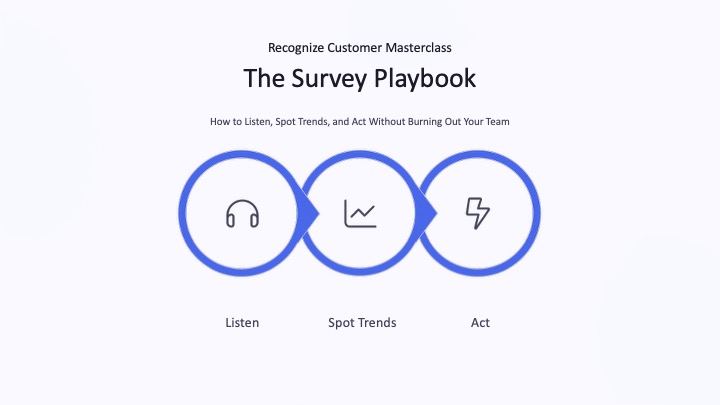
The Survey Playbook: How to Listen, Spot Trends, and Act Without Burning Out Your Team 📊
Speakers



Watch the Recording
Watch Now →About This Session
Is your team experiencing "survey fatigue," or are they just tired of taking surveys where nothing changes?
With global employee engagement sitting at just 20%, gathering honest feedback matters more than ever. But collecting data is only half the battle — the real value comes from turning that feedback into visible action.
Join us for an exclusive session on the science of survey strategy: what to survey, when to survey, and how to close the loop using recognition.
What you'll learn:
✔️ The 3-Tier Framework — balance eNPS, engagement checks, and quick custom pulses
✔️ Beat survey fatigue — build a 12-month calendar that keeps participation above 70%
✔️ Spot hidden trends — use heatmaps to find burnout and cross-reference engagement with recognition
✔️ The 7-Day Feedback Loop — turn survey data into visible changes and instant rewards
✔️ Live platform walkthrough — launch a custom pulse in under two minutes
Speakers & Hosts
Meet the people leading this session. Full bios and titles are shown below.
Head of Customer Success, Recognize
Customer Success Manager, Recognize
Customer Success Manager, Recognize
Transcript
WEBVTT
1
00:00:06.630 --> 00:00:09.190
Brittany Espinoza: Hello! Welcome, everyone!
2
00:00:12.670 --> 00:00:15.710
Samantha Liravongsa: Hey everyone, good to see some familiar faces.
3
00:00:20.010 --> 00:00:21.819
Brittany Espinoza: I'm gonna give it maybe…
4
00:00:22.860 --> 00:00:28.999
Brittany Espinoza: 60 seconds, and then we'll get started, and people can kind of join as we start.
5
00:00:40.880 --> 00:00:44.439
Brittany Espinoza: Oh, I got lost here, I couldn't figure out how to get to the chat.
6
00:00:50.660 --> 00:00:54.250
Brittany Espinoza: Hey, Lianne, how hot is it in Lauderdale?
7
00:00:57.320 --> 00:01:01.949
Brittany Espinoza: We're cooling down in the Pacific Northwest a little bit this week, thankfully.
8
00:01:03.990 --> 00:01:11.979
Samantha Liravongsa: Yes, same here in Colorado, which I'm happy about, but it's gonna get back up to, like, the hundreds next week.
9
00:01:12.110 --> 00:01:13.690
Samantha Liravongsa: It's short-lived.
10
00:01:13.690 --> 00:01:21.010
Brittany Espinoza: Ugh, yeah, I'm from Washington State, Lianne, so 96, to me, I would die.
11
00:01:21.370 --> 00:01:28.629
Brittany Espinoza: Like, we're not… we're not used to… to that hot over here. It hits 85, and we feel like it's 107.
12
00:01:32.930 --> 00:01:50.109
Brittany Espinoza: Okay, I think we're gonna go ahead and get started, because we have a lot to cover today, and, I want to make sure that we have time to get through everything. We are recording, so we will send out, a copy of the recording and the slides after, after we are finished today.
13
00:01:50.390 --> 00:01:54.059
Brittany Espinoza: So, today we are…
14
00:01:54.650 --> 00:02:06.439
Brittany Espinoza: Talking about surveys, we want to essentially build a practical survey strategy that is going to help you gather useful feedback
15
00:02:06.540 --> 00:02:22.890
Brittany Espinoza: without exhausting employees, or exhausting your managers, or your people ops team. We're gonna focus on 3 connected skills today. Listening intentionally, identifying meaningful patterns.
16
00:02:22.890 --> 00:02:28.399
Brittany Espinoza: And then translating that feedback into a visible response.
17
00:02:28.440 --> 00:02:43.570
Brittany Espinoza: The goal isn't to survey more frequently, it really is to make sure that every survey earns its place by connecting it to a real decision and, a credible response.
18
00:02:45.150 --> 00:02:50.020
Brittany Espinoza: So, let's take a look at, what our plan is for today.
19
00:02:52.890 --> 00:03:05.209
Brittany Espinoza: We have designed this webinar to be, a little bit more interactive, more of an interactive working session. We're gonna review 3 primary survey types.
20
00:03:05.440 --> 00:03:16.360
Brittany Espinoza: We're going to look at an overly broad survey and learn how we can improve that. We're going to interpret a sample heat map.
21
00:03:16.390 --> 00:03:27.500
Brittany Espinoza: And then, at the end, towards the end, we're going to actually dive into the recognized Survey feature and explore how we can support your survey efforts.
22
00:03:27.500 --> 00:03:44.419
Brittany Espinoza: at Recognize. As we start and we proceed through the webinar, I want you to start thinking about, one current organizational decision that would benefit from employee input. That might be something like.
23
00:03:44.420 --> 00:03:45.550
Brittany Espinoza: a…
24
00:03:45.710 --> 00:03:57.290
Brittany Espinoza: Policy change, a manager initiative, a new onboarding experience, some sort of workplace transition, or maybe just, like, a communication challenge.
25
00:03:57.290 --> 00:04:16.179
Brittany Espinoza: So just one example in your organization that you can think of that would benefit from having employee input. Think about that, jot it down. At the end of the webinar, we're going to use that example, during an action planning exercise.
26
00:04:21.890 --> 00:04:31.520
Brittany Espinoza: So, before we dive in, I want to start with a quick poll. Let's see. So, what I want to know is what…
27
00:04:31.820 --> 00:04:49.399
Brittany Espinoza: is your biggest survey challenge? I want to understand what brought everyone here. So, which challenge feels most familiar to you? Are you struggling with low participation? Do your employees feel like there are too many surveys?
28
00:04:49.400 --> 00:04:56.489
Brittany Espinoza: Do you or your team have difficulty interpreting those results?
29
00:04:56.640 --> 00:05:08.070
Brittany Espinoza: Do you see limited follow-through from your managers? Or are your employees not feeling like there is action taken on the survey results?
30
00:05:12.300 --> 00:05:18.379
Brittany Espinoza: I'll give you just a second to kind of, get these answers flowing through.
31
00:05:19.500 --> 00:05:24.509
Brittany Espinoza: I think we have… Almost everybody participating so far.
32
00:05:25.770 --> 00:05:30.340
Brittany Espinoza: So, low participation, definitely feel that one.
33
00:05:30.660 --> 00:05:41.859
Brittany Espinoza: Employees don't see action. Another one that, is sometimes a hidden reason, but, it's good, definitely, to… that… that we're recognizing that.
34
00:05:45.670 --> 00:05:52.340
Brittany Espinoza: And honestly, Sometimes survey strategy often breaks down at multiple points.
35
00:05:52.340 --> 00:06:12.860
Brittany Espinoza: So, if you're looking at this thinking, like, oh, they only gave me, you know, what… I can only choose one option, but a lot of these apply, you're not alone. In fact, again, like, survey strategy will often break down in multiple areas, and not only during the survey creation process, but afterwards as well.
36
00:06:13.020 --> 00:06:17.480
Brittany Espinoza: So, I think, we'll go ahead and share those real fast.
37
00:06:18.780 --> 00:06:21.879
Brittany Espinoza: Give us a minute to look at those results.
38
00:06:31.400 --> 00:06:37.600
Brittany Espinoza: Okay, so… Collecting feedback is a transaction.
39
00:06:38.310 --> 00:06:50.740
Brittany Espinoza: Surveying is not the same as listening. Listening includes showing employees how their input shaped a decision, or an action or explanation.
40
00:06:50.840 --> 00:07:00.930
Brittany Espinoza: That distinction really matters. Global employee engagement actually fell 20% in 2025, which is the lowest level since
41
00:07:00.930 --> 00:07:14.649
Brittany Espinoza: 2020, and we know what happened in 2020, and Gallup actually estimated that low engagement cost, the, it actually cost the global economy about $10 trillion in lost productivity.
42
00:07:14.720 --> 00:07:22.379
Brittany Espinoza: So an organization can gather substantial data while still making employees feel unheard.
43
00:07:22.420 --> 00:07:34.529
Brittany Espinoza: Before launching a survey, we need to identify what the information will help you decide, and how employees will learn what happened afterwards.
44
00:07:34.540 --> 00:07:48.050
Brittany Espinoza: If you aren't prepared, and willing to act and make visible changes based on the feedback that you receive, then asking the questions may actually do more harm than good.
45
00:07:54.040 --> 00:08:11.800
Brittany Espinoza: Survey fatigue is something that we hear a lot, and you might think that this is caused by too many surveys or survey frequency, but it actually often comes from unclear purpose, potentially irrev… irrevell…
46
00:08:11.900 --> 00:08:23.309
Brittany Espinoza: irrelevant questions, poor targeting, or missing follow-through. So, compare the, compare these two requests.
47
00:08:23.530 --> 00:08:47.219
Brittany Espinoza: So, you know, if you have a survey that says, please complete our annual 35-question employee survey, versus something like, we're deciding how to revise the new scheduling policy, these four questions will guide that decision, and we'll share our initial response next Friday. The second request tells employees.
48
00:08:47.220 --> 00:08:49.310
Brittany Espinoza: Why their input matters.
49
00:08:49.310 --> 00:08:57.449
Brittany Espinoza: and what will happen afterwards. So, before launching, every survey really should have 3 things.
50
00:08:57.600 --> 00:09:08.169
Brittany Espinoza: A decision that the feedback will inform, an owner responsible for the responses, and a communication plan.
51
00:09:08.360 --> 00:09:13.240
Brittany Espinoza: If one of those things is missing, your survey probably is not ready.
52
00:09:25.100 --> 00:09:37.939
Brittany Espinoza: So, today we're going to talk about three survey types, and they operate at different altitudes. We have EMPS, which provides an overall advocacy benchmark.
53
00:09:38.010 --> 00:09:52.369
Brittany Espinoza: Engagement surveys will diagnose conditions affecting performance and belonging. And then we have custom pulses, which will answer focused questions about a particular decision or experience.
54
00:09:52.370 --> 00:10:00.010
Brittany Espinoza: you don't need to run all three constantly. In fact, what you want to do, really, is to select the lightest
55
00:10:00.010 --> 00:10:04.740
Brittany Espinoza: Survey capable of providing the credible information.
56
00:10:05.590 --> 00:10:10.209
Brittany Espinoza: And a useful question is… that you can ask yourself is.
57
00:10:10.580 --> 00:10:25.449
Brittany Espinoza: Are we trying to benchmark, diagnose, or make a focused decision? And the answer to that question will usually point you to the appropriate survey that you need to use. So…
58
00:10:25.450 --> 00:10:42.530
Brittany Espinoza: We're gonna take just a little bit of time to dive into each of these three survey types, and talk about when to use those. I'm going to pass it to Sam, and she is going to take us a little bit deeper into each of those survey types, and she'll also help us practice
59
00:10:42.530 --> 00:10:46.199
Brittany Espinoza: Choosing which survey is the right one to use.
60
00:10:52.010 --> 00:10:53.510
Brittany Espinoza: You're on mute, Sam.
61
00:10:56.400 --> 00:10:57.779
Brittany Espinoza: We want to hear what you have to say.
62
00:10:57.780 --> 00:11:01.149
Samantha Liravongsa: Mari, thanks! I was just talking to myself over here.
63
00:11:02.780 --> 00:11:17.030
Samantha Liravongsa: Alright, so we'll go ahead and start with EMPS. Apologies, guys. This is your high-level temperature check, so it really boils down to one simple question. How likely are you to recommend your organization as a place to work?
64
00:11:17.120 --> 00:11:26.519
Samantha Liravongsa: So, employees, they're rating you from a 0 to 10, and then you have your promoters, and those are, your 9 to 10.
65
00:11:26.540 --> 00:11:39.849
Samantha Liravongsa: You have your passives, which sit at a 7 or 8, and then you have your detractors, which fall anywhere between 0 and 6. So, to get your score, subtract the percentage of detractors from your promoters.
66
00:11:40.570 --> 00:11:56.429
Samantha Liravongsa: And here's a little secret about EMPS. It's… its power is not to be a single score. A single score is just a snapshot in time, right? The magic is really when you're measuring consistently to build a clear trend line.
67
00:11:56.690 --> 00:12:09.579
Samantha Liravongsa: So one major caveat to keep in mind is never stop at the company-wide average. A healthy EMPS of positive 25 can easily hide a struggling department sitting at negative 10.
68
00:12:09.580 --> 00:12:18.649
Samantha Liravongsa: So your overall result tells you where to start looking, but it will never really tell you why employees feel the way they do. And for that, we need to dig deeper.
69
00:12:20.180 --> 00:12:39.939
Samantha Liravongsa: And that's gonna bring us into full engagement surveys, which step in to solve the why. So these comprehensive surveys help unpack whether employees are truly thriving by measuring core dimensions like role, clarity, resources, growth, belonging, and recognition.
70
00:12:40.210 --> 00:12:53.149
Samantha Liravongsa: Think about it this way. So, picture a team that gets frequent recognition, but they suffer from total role confusion. Sending another thank you card, it's not going to fix that unclear expectation or burnout.
71
00:12:53.830 --> 00:13:04.919
Samantha Liravongsa: So, Gallup's Q12 framework reminds us that receiving praise in the last 7 days is crucial, but recognition is still just one piece of a much larger puzzle.
72
00:13:05.760 --> 00:13:10.029
Samantha Liravongsa: So the golden rule for full engagement surveys… what is it?
73
00:13:10.090 --> 00:13:13.459
Samantha Liravongsa: Do you only run them when leadership is ready?
74
00:13:13.460 --> 00:13:31.380
Samantha Liravongsa: Or do you run them at the next cycle? So it's both of those things. You want to run them when leadership is ready to analyze the data and ready to act on it before the next cycle starts. So asking for feedback without taking action is really the fastest way to kill that employee trust, or participation.
75
00:13:35.180 --> 00:13:45.689
Samantha Liravongsa: And then when you need that speed and precision, you want to use a custom pulse. So a great pulse is short, it's razor sharp, it's tied directly to a specific decision.
76
00:13:45.750 --> 00:13:57.430
Samantha Liravongsa: So, when you're using the custom pulses, you want to make sure you keep it targeted to affected employees only. So, keep it under 3 minutes, using 3 to 5 questions max.
77
00:13:57.480 --> 00:14:15.290
Samantha Liravongsa: For instance, after launching a hybrid work policy, just for example, skip broad questions like, how do you like working here? Instead, ask which part of the current policy creates the most friction, or what is one adjustment that would improve your daily work?
78
00:14:15.290 --> 00:14:19.140
Samantha Liravongsa: Those are actionable questions that really drive change.
79
00:14:19.190 --> 00:14:29.060
Samantha Liravongsa: So, pro tip, if a question will not actively influence an impending decision, just cut it out. Also, I do want to remind everyone
80
00:14:29.060 --> 00:14:47.999
Samantha Liravongsa: that we do have these built-in Pulse templates, so those are straight from Gallup Q12, and we have the option to create your own custom Pulse Survey right within Recognize. We want to make sure that, we have the tools available for you guys to make creating surveys effortless as well.
81
00:14:50.190 --> 00:14:54.669
Samantha Liravongsa: So, now I want to get into an activity.
82
00:14:55.190 --> 00:15:01.760
Samantha Liravongsa: And I want to, I want everyone to kind of test your survey instincts with… with this quick, challenge.
83
00:15:02.020 --> 00:15:09.470
Samantha Liravongsa: look at all three world, real-world scenarios on the screen, and I want you to drop your answers in the chat.
84
00:15:10.800 --> 00:15:19.829
Samantha Liravongsa: So, scenario one, leadership wants a reliable quarterly culture indicator. What survey would we use for that?
85
00:15:20.410 --> 00:15:26.529
Samantha Liravongsa: And then, scenario number two, engagement score suddenly dropped, but no one knows why.
86
00:15:27.000 --> 00:15:31.979
Samantha Liravongsa: What survey would you… would come to mind when you want to, get a pulse on that?
87
00:15:32.640 --> 00:15:40.049
Samantha Liravongsa: And then scenario number 3, You launched a new hybrid work policy last month and need quick feedback.
88
00:15:42.830 --> 00:15:58.079
Samantha Liravongsa: So, either EMPS, Engagement Survey, or custom. Go ahead and drop 1, 2, 3, or which survey you would use in the chat. And if you want to put a quick reason why, feel free to do that as well. We'll give everybody a few moments to answer here.
89
00:16:13.540 --> 00:16:15.030
Samantha Liravongsa: Alright.
90
00:16:21.730 --> 00:16:23.749
Brittany Espinoza: I'm kind of scared to put my answers in.
91
00:16:32.190 --> 00:16:41.599
Samantha Liravongsa: And there's no wrong answer, I mean, this is what we're here for, right? This masterclass and workshop, to kind of learn what surveys to use for certain scenarios.
92
00:16:54.480 --> 00:16:56.829
Brittany Espinoza: Okay, I'm with you, Maria Lena.
93
00:16:57.780 --> 00:16:59.189
Brittany Espinoza: That's what I think.
94
00:16:59.520 --> 00:17:04.020
Brittany Espinoza: I… I hope I'm right, because I'm… Helping to host this webinar.
95
00:17:05.579 --> 00:17:08.350
Samantha Liravongsa: Seen's some good answers coming in here.
96
00:17:15.020 --> 00:17:22.810
Samantha Liravongsa: Okay, and if you're ready, let's kind of reveal the ideal matches. So, Scenario 1, EMPS. Who got that?
97
00:17:25.700 --> 00:17:33.990
Samantha Liravongsa: Alright, so it looks like we're all kind of on the same track. So that, again, it provides that fast, repeatable, quarterly benchmark that leadership needs.
98
00:17:34.140 --> 00:17:38.969
Samantha Liravongsa: Scenario number 2, we're looking, full engagement survey.
99
00:17:39.410 --> 00:17:47.389
Samantha Liravongsa: This is what you need to diagnose the root cause across all drivers to figure out why scores plummeted. You know, everybody's looking good here.
100
00:17:47.570 --> 00:17:48.710
Samantha Liravongsa: Alright!
101
00:17:50.180 --> 00:18:00.629
Samantha Liravongsa: And then Scenario 3, textbook custom pulse. It's timely, targeted, and directly tied to fine-tuning, those new policies. I think everybody got it right.
102
00:18:00.860 --> 00:18:09.049
Brittany Espinoza: You know what threw me off is that they're in, like, the order, like, EMPS Engagement and Pulse, so I was like, surely we didn't make it that easy.
103
00:18:09.050 --> 00:18:10.119
Samantha Liravongsa: Apparently, we did.
104
00:18:10.120 --> 00:18:10.920
Brittany Espinoza: We did.
105
00:18:13.280 --> 00:18:31.400
Samantha Liravongsa: And, you know, if you guys remember one concept from today, make it this rule. Use the lightest survey that can produce credible information for the decision at hand. A longer survey is never automatically a better survey, which Brittany had brought up when we first started talking about diving into these.
106
00:18:33.960 --> 00:18:35.320
Samantha Liravongsa: Alright!
107
00:18:35.350 --> 00:18:40.709
Samantha Liravongsa: So, let's look at what happens when survey design goes wrong. Here's a
108
00:18:40.710 --> 00:18:56.879
Samantha Liravongsa: you know, a before makeover example. This particular survey tries to do way too much at once. It packs in 15 questions. You're sending it to unimpacted staff, mixing unrelated topics, and lacks
109
00:18:56.880 --> 00:18:59.349
Samantha Liravongsa: Designated owner or action plan.
110
00:18:59.490 --> 00:19:10.940
Samantha Liravongsa: So, ask yourself this when you're reviewing surveys. Which of these questions will actually change our Phase 2 decision? If the answer is unclear, again, cut out the question.
111
00:19:10.990 --> 00:19:23.000
Samantha Liravongsa: Also, watch for massive open-ended prompts, like, please provide any additional feedback. They… these tend to generate a mountain of, unstructured noise that your team is not equipped to handle.
112
00:19:25.460 --> 00:19:28.870
Samantha Liravongsa: Now, take a look at the after transformation.
113
00:19:29.070 --> 00:19:39.490
Samantha Liravongsa: This revised survey centers entirely on one clear goal. It's deciding what to adjust before Phase 2. Its surveys only affected employees.
114
00:19:39.490 --> 00:19:49.639
Samantha Liravongsa: It asks for laser-focused questions, assigns the VP of people, or whoever you've designated, as the clear owner, and promises a response within 7 days.
115
00:19:49.800 --> 00:20:06.610
Samantha Liravongsa: The breakthrough here is not just the survey is shorter, the win is that the audience, the purpose, ownership, and response plan were all established before launch, which creates less friction, plus clearer intent, which equals a survey your employees actually trust.
116
00:20:07.280 --> 00:20:23.510
Samantha Liravongsa: We have now seen, you know, what focused survey design looks like in theory. Now, I'm happy to hand it over to Alexia, who's actually going to show you how one of our customers, actually turned real employee feedback into a massive, measurable result.
117
00:20:24.040 --> 00:20:26.590
Samantha Liravongsa: Alexia, it's off to you.
118
00:20:29.240 --> 00:20:47.640
Alexia Bailey: I will turn my mic on. So yes, we do have a customer story today. Unfortunately, Elizabeth from Gardner had a schedule conflict, so that's why I'm presenting her story instead of, being able to hear from her directly. But we're so grateful for her participation.
119
00:20:47.680 --> 00:21:02.910
Alexia Bailey: So, just to give you a little background about the company, Gardner uses building technology and data to find issues and solve problems for their clients to make their facilities safer, more comfortable, more efficient.
120
00:21:02.910 --> 00:21:10.730
Alexia Bailey: Think HVAC systems, building automation, energy solutions, fire safety, those kinds of things.
121
00:21:10.990 --> 00:21:13.660
Alexia Bailey: And culture is very important to Gardner.
122
00:21:13.680 --> 00:21:31.329
Alexia Bailey: They're very proud of the fact that 1 out of 5 of their employees have been with the company for more than 20 years, and their average associate tenure is 12 plus years. So there's obviously a lot that's going right with their culture, but they're always looking for ways to improve.
123
00:21:36.600 --> 00:21:48.839
Alexia Bailey: Oh, sorry, I, accidentally, flipped the… flipped the page. The, my system.
124
00:21:49.330 --> 00:21:51.180
Alexia Bailey: Oh, sorry.
125
00:21:51.180 --> 00:21:52.499
Brittany Espinoza: Can I give you the right slide?
126
00:21:53.140 --> 00:22:00.609
Alexia Bailey: It is… No, you're fine. You're fine now. I just… I have my… my… it's not…
127
00:22:00.610 --> 00:22:14.150
Alexia Bailey: my, setup on my screen is not ideal, so I apologize for that. After about a year after launching Recognize, Gardner wanted to understand whether their associates were using recognition in a meaningful way.
128
00:22:14.550 --> 00:22:23.889
Alexia Bailey: The team did not have a consistent, formal way to gather feedback, particularly from their field associates, before using the survey tool
129
00:22:24.030 --> 00:22:28.810
Alexia Bailey: before they, started with Recognize, which has the survey tool within it.
130
00:22:28.930 --> 00:22:34.769
Alexia Bailey: So Elizabeth created an anonymous survey so they would have a structured listening channel.
131
00:22:35.130 --> 00:22:38.509
Alexia Bailey: This is an important example of audience access.
132
00:22:39.460 --> 00:22:46.460
Alexia Bailey: Office employees may see an email right away, but field employees may have fewer natural opportunities to participate.
133
00:22:47.050 --> 00:22:55.030
Alexia Bailey: And the fact that it was anonymous is important. They wanted associates to feel like they could freely express what they really thought.
134
00:22:55.530 --> 00:23:11.179
Alexia Bailey: Once they had a chance to analyze the survey results, they did something I think is really smart. They shared the high-level results with all of their associates. They even posted the top takeaways in the announcements section of their recognized stream page.
135
00:23:13.160 --> 00:23:20.100
Alexia Bailey: But while hosting the high-level insights is a good start, It's not enough by itself.
136
00:23:20.220 --> 00:23:22.640
Alexia Bailey: Gardner was committed to acting on it.
137
00:23:22.950 --> 00:23:36.430
Alexia Bailey: They decided to start with one of the key insights, which was that while associates appreciate a shout-out from their peers, what would be even more meaningful would be to get more recognition from their direct managers.
138
00:23:36.780 --> 00:23:38.729
Alexia Bailey: Which totally makes sense.
139
00:23:38.930 --> 00:23:52.910
Alexia Bailey: Gallup has historically found that managers account for approximately 70% of the variation in engagement among teams, which helps explain why manager activation can be such a powerful lever.
140
00:23:54.030 --> 00:24:01.250
Alexia Bailey: So Gardner is focusing on engaging managers as the first priority in acting on the survey results.
141
00:24:01.550 --> 00:24:15.510
Alexia Bailey: It's still a work in progress, but they're already seeing results from their efforts. Participation from the field associates in particular has increased by 10.7% over the previous year.
142
00:24:16.180 --> 00:24:23.569
Alexia Bailey: One specific approach that I recommend for engaging managers is to use a manager's recognition challenge.
143
00:24:23.910 --> 00:24:25.300
Alexia Bailey: For example.
144
00:24:25.640 --> 00:24:31.020
Alexia Bailey: You can set up a challenge for managers to recognize at least one of their direct reports per week.
145
00:24:31.180 --> 00:24:38.560
Alexia Bailey: You can even set up a series of, say, 4 challenges over the course of 4 weeks to help them form a habit.
146
00:24:39.300 --> 00:24:46.550
Alexia Bailey: Whatever tactics you use, the most important lesson is the sequence. Number one, listen to your employees.
147
00:24:47.200 --> 00:24:50.870
Alexia Bailey: Number two, identify a practical opportunity.
148
00:24:51.330 --> 00:24:54.229
Alexia Bailey: Number 3, activate your managers.
149
00:24:54.400 --> 00:24:57.329
Alexia Bailey: And number four, measure the response.
150
00:25:00.860 --> 00:25:03.430
Brittany Espinoza: And thank you to Gardner for sharing your story.
151
00:25:04.380 --> 00:25:13.760
Alexia Bailey: Yes, indeed. So this, simple survey calendar provides a structure without turning every single month into a survey cycle.
152
00:25:13.930 --> 00:25:18.339
Alexia Bailey: Quarterly EMPS provides a consistent benchmark.
153
00:25:18.450 --> 00:25:32.330
Alexia Bailey: April and October engagement surveys give you deeper diagnostics, and custom pulses, those are event-driven, so they're not automatically scheduled. And December, well, we'll all need a break in December, right?
154
00:25:32.820 --> 00:25:51.580
Alexia Bailey: But most importantly, the golden rule is to report back on the previous survey before launching the next one. That way, your employees can see that it's not a check-the-box exercise to collect data, but rather, it's the first step in finding a data-driven next step for improvement.
155
00:25:54.790 --> 00:26:09.419
Alexia Bailey: You'll also want to think about… oh, sorry. Ideally, you want to get at least 70% participation to ensure you have enough data to provide accuracy. That won't happen on its own, though. So here are a few tips.
156
00:26:09.690 --> 00:26:18.899
Alexia Bailey: Make sure that you have a communication plan for your survey. People need to know about it, and they also need to understand why you're asking them to take the time to respond.
157
00:26:19.630 --> 00:26:29.579
Alexia Bailey: Targeting the smallest relevant audience will help you get more relevant results, because a very large, diffuse group will have multiple competing priorities and needs.
158
00:26:30.300 --> 00:26:36.809
Alexia Bailey: It's also important to give people enough time to respond, especially if you have a significant number of field staff.
159
00:26:37.020 --> 00:26:42.459
Alexia Bailey: But don't keep it out so long that people will put it off indefinitely thinking, I'll just do it later.
160
00:26:43.390 --> 00:26:51.220
Alexia Bailey: You'll also want to think about the best timing and format for reminding people to participate before the survey period is over.
161
00:26:52.330 --> 00:27:06.110
Alexia Bailey: It may not always be possible to share full results within a week, but you may be able to give a preview that quickly, and then follow up with more details, and either provide a plan, or at least an assurance that the results will be acted on.
162
00:27:06.370 --> 00:27:12.299
Alexia Bailey: Last, but definitely not least, Use the insights to make things better.
163
00:27:12.480 --> 00:27:23.419
Alexia Bailey: Not only is that the whole point of the exercise, but it will also encourage people to take the next survey when you want to learn how your adjustments landed and determine what's next.
164
00:27:25.780 --> 00:27:33.880
Alexia Bailey: And once you have the responses, participation scores and comments all answer different questions about your survey results.
165
00:27:34.120 --> 00:27:38.630
Alexia Bailey: Participation, that shows who was willing and able to respond.
166
00:27:38.930 --> 00:27:43.050
Alexia Bailey: Scores describe the experience of those respondents.
167
00:27:43.310 --> 00:27:47.610
Alexia Bailey: The comments then provide context about why they answered that way.
168
00:27:48.130 --> 00:27:58.119
Alexia Bailey: A high average with a weak participation may be less representative than a moderate score supported by broad participation and consistent themes.
169
00:27:58.800 --> 00:28:09.110
Alexia Bailey: So, a useful review sequence is check participation, Review the score distribution, Read recurring comment themes.
170
00:28:09.440 --> 00:28:11.740
Alexia Bailey: Compare the relevant segments.
171
00:28:11.920 --> 00:28:14.139
Alexia Bailey: And decide what requires follow-up.
172
00:28:15.470 --> 00:28:29.929
Alexia Bailey: So having considered, what to look at in an initial evaluation, now I'm going to hand it back to Sam, who's going to show us how to apply that thinking to a heat map, identify the strongest signal, and decide what to investigate next.
173
00:28:30.440 --> 00:28:45.050
Samantha Liravongsa: Awesome, thanks, Alexia, and thank you for sharing Gardner's story. Really awesome to hear their success with Survey. So, everybody, I'm gonna ask you to put your detective hats back on, and go ahead and take a look at this illustrative data heatmap.
174
00:28:45.190 --> 00:28:47.990
Samantha Liravongsa: And just take a moment to study the numbers on the screen.
175
00:28:48.410 --> 00:28:55.540
Samantha Liravongsa: I want you to drop your thoughts in the chat, using these four prompts. Where would you investigate first?
176
00:28:55.710 --> 00:29:01.799
Samantha Liravongsa: Which additional segment would you examine next? What should you avoid concluding right away?
177
00:29:01.990 --> 00:29:05.020
Samantha Liravongsa: What focused pulse Survey might you send next?
178
00:29:06.420 --> 00:29:14.300
Samantha Liravongsa: And as you think about it and type your answers in the chat, keep the three levels of data interpretation in mind. What…
179
00:29:14.510 --> 00:29:19.620
Samantha Liravongsa: What the data clearly shows, what it might suggest, and what it cannot establish.
180
00:29:20.870 --> 00:29:27.489
Samantha Liravongsa: So I'll just give everybody a minute here to think about it. Again, there's no wrong answer.
181
00:29:33.870 --> 00:29:38.530
Samantha Liravongsa: So… As we're looking at the chart.
182
00:29:40.180 --> 00:29:53.469
Samantha Liravongsa: What the data shows here is that the field team scored 41 engage… when we're talking about their, engagement score here, compared to the company average of 72.
183
00:29:53.780 --> 00:29:58.290
Samantha Liravongsa: Now, that's a pretty big difference, but here's the critical distinction.
184
00:29:58.730 --> 00:30:03.939
Samantha Liravongsa: The data shows us that they scored lower. It doesn't show us why, though.
185
00:30:05.810 --> 00:30:09.599
Samantha Liravongsa: Brittany, you took the words right out of my mouth.
186
00:30:09.600 --> 00:30:11.249
Brittany Espinoza: to participate, Sam!
187
00:30:15.380 --> 00:30:18.530
Samantha Liravongsa: Alrighty, so let's go ahead and kind of do a…
188
00:30:18.680 --> 00:30:22.459
Samantha Liravongsa: A debrief here on, on this heat map analysis.
189
00:30:22.840 --> 00:30:31.900
Samantha Liravongsa: So, the field team is obviously our starting point, right? But a low score is a signal to explore, not a final conclusion to act on.
190
00:30:32.230 --> 00:30:38.100
Samantha Liravongsa: Our goal is to follow a clear process. Signal, segment, validate, pulse.
191
00:30:38.340 --> 00:30:55.300
Samantha Liravongsa: So first, you want to segment the data deeper by, think about location, manager group, tenure, specific role. You want to review participation rates and read open text comments, then launch a targeted pulse survey to test your hypothesis.
192
00:30:55.700 --> 00:31:04.320
Samantha Liravongsa: So ask direct questions like, what most affects your ability to do your best work, or what is one change that would make the greatest difference?
193
00:31:04.470 --> 00:31:15.529
Samantha Liravongsa: The entire goal of data analysis is turning the raw signal into a better question, rather than jumping straight from a low score to a misguided solution.
194
00:31:19.590 --> 00:31:26.890
Samantha Liravongsa: And then to unlock the full picture, pair your engagement survey results directly with your recognition data.
195
00:31:27.160 --> 00:31:34.089
Samantha Liravongsa: Plotting them into these four quadrants gives you an immediate action plan before you even close your report.
196
00:31:34.380 --> 00:31:38.739
Samantha Liravongsa: So when we're talking about high engagement plus high recognition.
197
00:31:38.950 --> 00:31:42.909
Samantha Liravongsa: This reinforces what is working, and that's what you want to keep doing.
198
00:31:43.600 --> 00:31:47.929
Samantha Liravongsa: When you have low engagement and low recognition.
199
00:31:48.860 --> 00:31:53.240
Samantha Liravongsa: Maybe you want to start prioritizing manager support immediately.
200
00:31:54.450 --> 00:31:58.280
Samantha Liravongsa: And then when we have high recognition and low engagement.
201
00:31:58.620 --> 00:32:08.169
Samantha Liravongsa: Your recognition is happening, but other factors, like role clarity, resources, workload, or growth opportunities may be holding people back.
202
00:32:09.000 --> 00:32:20.309
Samantha Liravongsa: And then when you have high engagement and low recognition, treat this as an early warning. Momentum's strong today, but employees may need to feel substantially valued over time.
203
00:32:20.540 --> 00:32:35.720
Samantha Liravongsa: Because you always want to inspect what type of recognition is happening. How is that recognition happening? This, you want to spot any gaps, or maybe there's an issue with manager engagement or leadership buy-in. These are going to be…
204
00:32:35.940 --> 00:32:36.830
Samantha Liravongsa: you know.
205
00:32:37.340 --> 00:32:56.690
Samantha Liravongsa: cues for you to know what's working, where you need to prioritize, and what you need to work on. So once you understand what the data is telling you, the next question is how to respond credibly. And with that, Brittany's gonna go ahead and walk us through the response timeline and show us how those pieces come together inside Recognize.
206
00:32:58.140 --> 00:33:01.610
Brittany Espinoza: Perfect. Thank you, Sam. So…
207
00:33:01.780 --> 00:33:26.490
Brittany Espinoza: Alexia mentioned this a few slides ago, and so I want to dive a little bit more into what the 7-day response loop actually means. So don't get scared. This doesn't mean that you have to have everything solved or communicate a full action plan based on the data and the answers that you received within 7 days.
208
00:33:26.490 --> 00:33:35.030
Brittany Espinoza: That's not what this is. 7 days is the communication commitment, not the deadline for solving every issue.
209
00:33:35.230 --> 00:33:59.110
Brittany Espinoza: For example, an organization couldn't redesign compensation within 7 days, if that's perhaps an opportunity that is identified from a Pulse survey, but what it can do is acknowledge that compensation emerged as a concern, it can publicly name the person who is going to be responsible for
210
00:33:59.110 --> 00:34:11.260
Brittany Espinoza: Reviewing the issue. Explain the review process, perhaps, clarify what information is going to be considered in the decision-making process.
211
00:34:11.260 --> 00:34:30.000
Brittany Espinoza: And then, also important is to commit to a date for the next update. So, you're not committing to when the issue's necessarily going to be solved, but you're committing to working towards a solution, and you're committing to, communicating on that progress. So.
212
00:34:30.239 --> 00:34:35.890
Brittany Espinoza: Within 7 days, employees should understand what was heard.
213
00:34:36.010 --> 00:34:38.760
Brittany Espinoza: And what's going to happen next?
214
00:34:38.969 --> 00:34:53.410
Brittany Espinoza: Silence is what creates uncertainty. A credible response is going to protect trust while the team works on a long-term solution.
215
00:35:01.820 --> 00:35:13.259
Brittany Espinoza: So, we want to, actually separate the initial response from the longer-term delivery. So, within 7 days, we're acknowledging and communicating.
216
00:35:13.260 --> 00:35:32.599
Brittany Espinoza: And then the goal is that within 30 days, we can decide and begin on the priority action. So you're kind of having that 30 days to, look at the results, analyze a little bit deeper into what those overarching themes that initially emerged were.
217
00:35:32.600 --> 00:35:39.620
Brittany Espinoza: And then within 60 to 90 days, we want to make sure that we are delivering,
218
00:35:39.620 --> 00:35:53.099
Brittany Espinoza: meaningful progress that can really be measured. And these are, remember, guiding intervals. They're not universal deadlines, so this is just a guide, because
219
00:35:53.100 --> 00:36:15.970
Brittany Espinoza: problems are going to take different amounts of time to, to work on and to change. So, a policy wording change, for example, might be able to happen really quickly and might fall… this may be way too much time for that type of a change, but something regarding, like, compensation or, staffing changes or system changes
220
00:36:15.970 --> 00:36:20.899
Brittany Espinoza: could potentially take longer. So really the key is
221
00:36:20.900 --> 00:36:39.819
Brittany Espinoza: communication, and making sure that employees know that something is being done with the feedback that they have shared. Again, going back to, one of the first slides that we shared about survey fatigue, I don't think most
222
00:36:39.850 --> 00:36:47.719
Brittany Espinoza: Employees are tired of sharing their feedback or their ideas. They're tired of
223
00:36:48.060 --> 00:37:10.050
Brittany Espinoza: being asked, but not feeling like they're being heard. So it's really just about communication. These are timeline guidelines, but as long as you are communicating with your employees, recognizing what was heard in the survey, and committing to progress in that area, and sharing updates along the way.
224
00:37:10.050 --> 00:37:15.509
Brittany Espinoza: Then, then you're doing your job, and employees are going to feel like.
225
00:37:15.550 --> 00:37:25.050
Brittany Espinoza: they want to share their feedback because they feel like they're being heard and listened to. And another thing is that recognition can really reinforce
226
00:37:25.050 --> 00:37:38.780
Brittany Espinoza: the progress. So, for example, if employees request better cross-department communication, recognizing, for example, the managers who begin to effectively,
227
00:37:39.060 --> 00:37:47.940
Brittany Espinoza: cross-functionally recognize, we want to recognize the managers that are doing that. So, recognize can really help
228
00:37:48.150 --> 00:38:11.259
Brittany Espinoza: emphasize that the changes are happening, and again, we want to, tie it back to the survey results. So, for example, you know, I'm gonna recognize these four managers, and I can say something like, we heard in the surveys that employees wanted more cross-department communication.
229
00:38:11.260 --> 00:38:15.729
Brittany Espinoza: And we've seen these examples of you helping with that initiative.
230
00:38:24.790 --> 00:38:47.230
Brittany Espinoza: Okay, so, we… it's been a few months, a couple months, since we've dove into the platform, into Recognize, to, do, like, a live demo. So, I thought today would be a perfect opportunity to just do a quick guided tour of the Recognize Survey feature. And rather than
231
00:38:47.230 --> 00:38:54.600
Brittany Espinoza: building an entire survey, I'm going to show you the different paths available, depending on what you need to learn.
232
00:38:55.560 --> 00:39:09.949
Brittany Espinoza: Let's see… hopefully I'm set up correct here. Perfect. So, hopefully we can all see our, demo account here, Redwood Services, which is our pretend hospital, and…
233
00:39:10.630 --> 00:39:33.979
Brittany Espinoza: When we dive into the company admin portal, you'll see the surveys option here. So, if you've never created a survey, it'll actually drop you to this page, but if you have created a survey before, you'll see any active surveys that you have going on, and if you want to create a new survey, then you just click New Survey.
234
00:39:33.980 --> 00:39:36.910
Brittany Espinoza: So, on this page,
235
00:39:36.910 --> 00:40:00.269
Brittany Espinoza: the three survey types that we have been talking about are all represented here when you're starting to create a survey. So, EMPS was one of the first ones that we talked about. We have that built in to recognize, and so you're going to get, the true EMPS score, and this can be your ongoing culture, score throughout the year.
236
00:40:00.750 --> 00:40:16.659
Brittany Espinoza: We also have, templates built for engagement surveys, so if you need some help in creating an actual engagement survey, we have a couple of options here. We have, employee engagement, which is based off of the Gallup 12.
237
00:40:16.670 --> 00:40:41.670
Brittany Espinoza: And then we also have a longer employee happiness Survey that is 20 questions. And both of these are, are customizable once you get in there, so it's a great starting point if you're kind of struggling with, what questions to ask or where to start. It's great to start with one of these, and then you can actually go in once you get in here, you can actually go in and customize
238
00:40:41.670 --> 00:40:43.020
Brittany Espinoza: these questions.
239
00:40:43.020 --> 00:40:48.150
Brittany Espinoza: To be a little bit more relevant to your industry or your organization.
240
00:40:48.770 --> 00:40:55.629
Brittany Espinoza: And then when we're talking about pulse surveys, where you're really asking just two to three pulse
241
00:40:55.630 --> 00:41:19.059
Brittany Espinoza: pointed questions. You also have the ability to come in and create a custom survey, where you decide what questions you're asking. And if you've used a survey product before, it's going to be very familiar where you can add questions, and you can add, different types of answering mechanisms.
242
00:41:19.640 --> 00:41:38.790
Brittany Espinoza: You can do things like making questions, required or not required, multi-select, all that fun stuff. You can also give your survey a theme, so if you wanted to add a header photo, or maybe you wanted to add a fun background color,
243
00:41:38.790 --> 00:41:57.300
Brittany Espinoza: you can… you can definitely come in here and brand and customize your survey as well. You can also set logic, you can set rules where, you know, for example, if they answer yes to this question, take them here next. If they answer no to this question, take them here next. And that's really important, I think, for
244
00:41:57.300 --> 00:42:04.710
Brittany Espinoza: Pulse surveys, specifically, and really just, making…
245
00:42:04.710 --> 00:42:29.689
Brittany Espinoza: your surveys as short as possible, because if, based on one question, if the next three won't be relevant, rather than making that employee click no or, you know, take time with those extra questions, you can allow those to kind of be skipped and shorten that survey for that person. So, logic is really important. It's not… not just kind of an operational thing, but you can use
246
00:42:29.690 --> 00:42:32.440
Brittany Espinoza: it in a way that makes your survey more effective.
247
00:42:32.820 --> 00:42:40.630
Brittany Espinoza: Some of the other things… let me go, actually, into… Here…
248
00:42:40.910 --> 00:42:49.509
Brittany Espinoza: Sure, well, good to hear. So, for example, here's an EMPS survey. You can actually set up,
249
00:42:49.860 --> 00:43:02.180
Brittany Espinoza: open periods for your survey. So, I think Alexia in one of… in her time… her survey timeline for the year, had suggested EMPS
250
00:43:02.180 --> 00:43:26.890
Brittany Espinoza: being run quarterly. So let's say you want to open EMPS for the first two weeks of every quarter, so that you're getting a quarterly pulse check. You can set that up at the beginning of the year, and have this automatically run for those two weeks at the beginning of every quarter, and not have to worry about coming back in and setting anything up. The only thing you would do is come in and see what the results were
251
00:43:26.890 --> 00:43:29.209
Brittany Espinoza: after. So, you can go ahead and just
252
00:43:29.210 --> 00:43:36.760
Brittany Espinoza: Set multiple time periods, and they will automatically start and automatically close based on the dates that you provide.
253
00:43:37.290 --> 00:43:46.970
Brittany Espinoza: The other thing that… Is important to look at is audience. So…
254
00:43:48.240 --> 00:43:52.460
Brittany Espinoza: Again, you want your surveys to,
255
00:43:52.720 --> 00:43:56.639
Brittany Espinoza: really only survey the people who it…
256
00:43:56.640 --> 00:44:19.140
Brittany Espinoza: impacts, and that's the power of Pulse surveys, is that you don't have to send it to everybody. If it's a change with just a certain department, or something that really only impacts a certain group, or maybe a certain level of employees, you can actually customize who this survey goes to based on pre-configured roles inside of Recognize.
257
00:44:19.720 --> 00:44:34.160
Brittany Espinoza: You can also decide how often you want them to be able to submit. So, a lot of people will actually run their EMPS and just have it open all year, so you can go in and submit, you know, an EMPS,
258
00:44:34.250 --> 00:44:46.010
Brittany Espinoza: anytime you want to, but you might want to, say, limit responses to once per quarter, or once per month, for example. So you've got all of those options in there as well.
259
00:44:46.770 --> 00:44:48.020
Brittany Espinoza: And then…
260
00:44:48.570 --> 00:45:03.049
Brittany Espinoza: The other really important thing that will help with, that 70% response rate, which is really the goal that we're… that we're going for, and what tells us that we have a really solid, survey collection process.
261
00:45:03.050 --> 00:45:21.720
Brittany Espinoza: is, reminders. So, with recognized surveys, we actually take care of that piece for you. We, based on the settings that you configure, we will send up to 3 survey reminders during your survey period. So, let's say you're doing your semi-annual engagement.
262
00:45:21.720 --> 00:45:25.370
Brittany Espinoza: Survey, and it's open for 1 month.
263
00:45:25.370 --> 00:45:29.890
Brittany Espinoza: We will send a notification to all of the employees
264
00:45:29.890 --> 00:45:54.340
Brittany Espinoza: who, are allowed to complete the survey. So again, if you've… if you've selected just a certain audience, the notifications would just go out to that group. But we'll send an email when the survey period opens, letting them know that the survey is now available and requesting their input. And then we will send a reminder about halfway through the time period, and then we will send a
265
00:45:54.340 --> 00:46:19.110
Brittany Espinoza: final reminder about 5 days before the period ends, just basically saying, last call, don't forget to, share your feedback. And these are really smart reminders, so if somebody has already, maybe within the first week they complete their… they go in and they complete the survey, they won't get the next two reminders. So we're really only reaching out to, the folks that have not yet shared their feedback.
266
00:46:19.200 --> 00:46:23.479
Brittany Espinoza: So I think this is really important. I actually just,
267
00:46:23.670 --> 00:46:43.629
Brittany Espinoza: worked with a customer on, surveys, switching their survey, actually, this customer is, I think, actually, in the, in this webinar today. But I just worked with a customer moving their surveys, from
268
00:46:44.170 --> 00:46:49.689
Brittany Espinoza: outside of recognize, into Recognize, and
269
00:46:49.880 --> 00:47:03.010
Brittany Espinoza: One of the things that they really valued was, the reminders, the automated reminders, and it really took their response rates from
270
00:47:03.030 --> 00:47:13.479
Brittany Espinoza: Like, hardly not… like, they were really struggling with their response rates, up to just when the first survey that they did with these reminders, over 50%.
271
00:47:13.480 --> 00:47:32.689
Brittany Espinoza: So, so really, really, good to just have these reminders, something that you don't have to worry about, not, something that you have to manually go in and, and manage or remember to do, because we know that, you have a lot on your plates. We're going to take care of that for you.
272
00:47:32.840 --> 00:47:51.169
Brittany Espinoza: And then, of course, we have, all of your data available. So, all the responses will show here. Let me actually go to this example. This might have a little more data in here. So, responses, you'll see all of the resp… oh, is that where I was?
273
00:47:51.910 --> 00:47:53.599
Brittany Espinoza: No, I want to go to this one.
274
00:47:54.560 --> 00:47:58.379
Brittany Espinoza: So you'll see a table of all the responses to the questions.
275
00:47:58.380 --> 00:48:18.380
Brittany Espinoza: And then, you will also see a bunch of other data, like, how many completed versus how many it was sent to, and then, like, during the time period, when it was completed. So, this is fun, too, because you'll probably see, like, spikes with the notifications.
276
00:48:18.380 --> 00:48:31.829
Brittany Espinoza: So you'll know that those notifications are working. And then, based on each question, you'll have a little graph that shows you kind of where… this is your heat map, right? This is where, those questions kind of fell.
277
00:48:32.440 --> 00:48:36.759
Brittany Espinoza: And then… oh, and then again, your responses. So…
278
00:48:37.240 --> 00:49:00.840
Brittany Espinoza: Any questions before I pop out of the demo? I can show kind of what that looks like as an end user. So, again, when I am an end user going to complete a survey, I'm only going to see here what I have permission to complete. So, if there's an audience restriction.
279
00:49:01.060 --> 00:49:24.889
Brittany Espinoza: that I'm not included in, I won't see that here. But I'll be able to go to my Surveys tab, and I'll see cards for all the surveys that are available for me, and I can take those surveys right within Recognize. And another benefit to having your surveys inside of Recognize is the data that we have seen at Recognize is that when somebody
280
00:49:24.890 --> 00:49:46.579
Brittany Espinoza: gets into their Recognize profile, for any reason, there's an over 80% chance that they will send a recognition while they are there. So having that survey be completed in Recognize, and really getting them into Recognize for any reason, whether it's to submit a nomination, to complete a task.
281
00:49:46.580 --> 00:50:04.540
Brittany Espinoza: To view a company announcement, or to complete a survey. While they're there, there's an 80% chance that they will also send somebody a recognition. So, having all of those tools in one place is going to help your overall engagement as well.
282
00:50:07.250 --> 00:50:08.450
Brittany Espinoza: Okay.
283
00:50:08.670 --> 00:50:13.620
Brittany Espinoza: Let's see here… Let me go back to my slides…
284
00:50:13.920 --> 00:50:30.639
Samantha Liravongsa: And Brittany, do you recall when we first started notifications? We know it works because we had a customer accidentally enable an EMPS and triggered the first notification, and he was so surprised. He had, like, 50% participation, and he was like, I didn't expect.
285
00:50:30.640 --> 00:50:34.549
Brittany Espinoza: He didn't even… and he didn't even know he was running the survey.
286
00:50:34.640 --> 00:50:52.249
Brittany Espinoza: So that was positive. Yeah, so the notifications are great, and again, just a real time saver. Okay, so at the beginning of the call, I asked you guys to think about one real decision from your organization,
287
00:50:52.250 --> 00:51:01.620
Brittany Espinoza: that a pulse survey would help, inform. So, what I want to do is,
288
00:51:01.620 --> 00:51:18.689
Brittany Espinoza: you know, you can do it in the chat, or you can do it, you know, in your notes, on your computer, wherever, but I want to invite you to, use that example, and, try to… doesn't have to be perfect, but just try to kind of quickly create a, a useful
289
00:51:18.690 --> 00:51:35.850
Brittany Espinoza: Pulse Survey. So, the questions that we want to identify, and you can do this, on your own or in the chat, and if you're… if anybody's brave enough, to, share what they came up with afterwards, we'd love to take you off mute and let you share as well.
290
00:51:35.850 --> 00:51:41.199
Brittany Espinoza: So we want to, think about the decision that the pulse is going to inform.
291
00:51:41.260 --> 00:51:51.079
Brittany Espinoza: We want to think about who are the employees that are affected by the problem or the decision that you're trying to
292
00:51:51.280 --> 00:51:52.570
Brittany Espinoza: inform.
293
00:51:53.410 --> 00:52:03.150
Brittany Espinoza: Two questions, two to three questions, that will be really focused on what you're trying to inform.
294
00:52:03.770 --> 00:52:12.600
Brittany Espinoza: Who would be responsible for, making any changes based on that feedback that you get?
295
00:52:13.050 --> 00:52:16.430
Brittany Espinoza: A date that the themes
296
00:52:16.630 --> 00:52:21.060
Brittany Espinoza: Or the overarching feedback, that was shared.
297
00:52:21.280 --> 00:52:27.649
Brittany Espinoza: will be available for employees. When the next progress update will be.
298
00:52:27.790 --> 00:52:32.549
Brittany Espinoza: And how recognition can reinforce the action.
299
00:52:37.500 --> 00:52:46.180
Brittany Espinoza: Let's give it… I'm gonna challenge you and give you only one minute to create a Pulse survey.
300
00:52:50.580 --> 00:53:08.240
Brittany Espinoza: And if anybody, as you're doing this, if anybody is, brave enough to share what they came up with, again, doesn't have to be perfect, we only had one minute to prepare this, let us know in the chat, and we'll, we can take you off mute and…
301
00:53:08.500 --> 00:53:12.080
Brittany Espinoza: Let you share, or you can also feel free to share in the chat.
302
00:53:27.200 --> 00:53:32.389
Brittany Espinoza: I'm going to pop an example that I came up with.
303
00:53:32.570 --> 00:53:34.729
Brittany Espinoza: That is,
304
00:53:35.400 --> 00:53:42.949
Brittany Espinoza: Sort of is, actually relevant to… let's see if it's gonna share nicely… to our organization.
305
00:53:44.690 --> 00:53:46.999
Brittany Espinoza: Just as an example…
306
00:54:11.500 --> 00:54:13.570
Brittany Espinoza: Okay, so here was the…
307
00:54:13.570 --> 00:54:15.930
Samantha Liravongsa: You just shared it, to me, Brittany.
308
00:54:16.130 --> 00:54:16.660
Brittany Espinoza: Oh.
309
00:54:17.550 --> 00:54:20.339
Brittany Espinoza: That's okay, I'll just… I'll go over it,
310
00:54:20.640 --> 00:54:23.680
Brittany Espinoza: Since I don't have anybody else…
311
00:54:25.460 --> 00:54:32.560
Brittany Espinoza: popping up that wants to share. So here is the example that I came up with for our team. So,
312
00:54:33.290 --> 00:54:49.009
Brittany Espinoza: Imagine that your organization just recently introduced a new scheduling process, and employees have shared informal concerns, you've heard it maybe through the grapevine, about workload and coverage.
313
00:54:49.010 --> 00:54:55.750
Brittany Espinoza: So in this scenario, the employees affected are the customer support team.
314
00:54:55.890 --> 00:55:05.050
Brittany Espinoza: So, two survey questions that, would be good for a quick pulse survey could be something like…
315
00:55:05.050 --> 00:55:27.580
Brittany Espinoza: on a scale of 1 to 5, how manageable has your workload felt since the new scheduling process began? And that gives you a rating, that you can really kind of look at a heat map and see kind of where everybody falls. And then number two is, what is one change that would most improve workload or coverage?
316
00:55:28.130 --> 00:55:37.500
Brittany Espinoza: And in this pulse Survey the owner could be, director of customer support, and, you know, maybe working with the HR business partner.
317
00:55:38.170 --> 00:55:53.380
Brittany Espinoza: And given that today's August 27th, and kind of sticking with our 7-day loop, feedback loop, initial themes, so again, we're not solving the problem yet, but initial themes where we're saying, hey.
318
00:55:53.450 --> 00:56:01.850
Brittany Espinoza: Thank you for sharing your feedback. This is what we heard. We'd want to share those by maybe end of next week, so maybe September 4th or 5th.
319
00:56:01.930 --> 00:56:26.739
Brittany Espinoza: The team would explain what they heard, what they can act on immediately, and what might require more review. And then your next progress update might be sometime in October, and then, you know, 6 to 9 months until everything is finalized, again, just based on what we're trying to solve here. And recognition can really, reinforce the response by
320
00:56:26.740 --> 00:56:27.540
Brittany Espinoza: I…
321
00:56:27.730 --> 00:56:38.770
Brittany Espinoza: Number one, thanking the entire team for participating, and also recognizing the managers or employees who might help test and implement improvements.
322
00:56:38.790 --> 00:56:47.690
Brittany Espinoza: Recognition should never be tied to giving a positive answer. And this is really important because we want people to feel safe.
323
00:56:47.690 --> 00:57:10.390
Brittany Espinoza: in sharing their feedback, whether it's positive or negative. And we really want to celebrate participation, collaboration, and then follow through. So, notice that this plan, doesn't promise to solve every workload concern, and certainly not immediately, but what it does do is creates a focus way to listen.
324
00:57:10.390 --> 00:57:18.289
Brittany Espinoza: Assigns responsibility, and gives employees clear dates for hearing what's going to happen next.
325
00:57:21.220 --> 00:57:29.800
Brittany Espinoza: So hopefully you guys were able to come up with something, on your end, maybe a challenge that you've been hearing,
326
00:57:30.420 --> 00:57:48.650
Brittany Espinoza: But I would challenge, everybody to, think about this. If you couldn't think of something today during, during the webinar, think about this, and my challenge to you is to launch one purposeful, poll survey sometime this quarter.
327
00:57:48.790 --> 00:57:56.730
Brittany Espinoza: And this quarter's important, because don't do it in Q4, because people are in the holiday mode there. So, do it before the end of this quarter.
328
00:57:57.740 --> 00:57:59.430
Brittany Espinoza: Okay, we…
329
00:57:59.810 --> 00:58:07.879
Brittany Espinoza: Didn't leave too much time for questions, but, we are… we are… we do have a couple minutes left, if anybody has any questions.
330
00:58:07.880 --> 00:58:22.840
Brittany Espinoza: I am going to pop the questions in the chat if you have them. I'm going to, in the follow-up email, I will, yes, great question, Beth. I am going to send the survey playbook
331
00:58:22.840 --> 00:58:29.450
Brittany Espinoza: in my follow-up email, so I will make sure that everybody gets that. And then,
332
00:58:31.540 --> 00:58:33.650
Brittany Espinoza: If you have a CSM,
333
00:58:34.160 --> 00:58:42.969
Brittany Espinoza: it's likely one of us. Go ahead and, book time with us if you want to talk through your specific,
334
00:58:42.970 --> 00:58:59.890
Brittany Espinoza: challenges or specific things that you might want to survey, we would love to kind of help you plan your next survey. If you do not have an assigned CSM, just email support at recognizeapp.com, and one of us will be happy to meet with you and help you through that.
335
00:59:00.380 --> 00:59:10.759
Brittany Espinoza: And again, my challenge to you is to put today's framework into practice and launch one Purposeful Pulse Survey this quarter.
336
00:59:10.870 --> 00:59:18.520
Brittany Espinoza: Thank you guys so much for joining. This was a really fun session. I do have, a quick survey.
337
00:59:19.430 --> 00:59:32.560
Brittany Espinoza: on par with today's topic that will pop up after we end the webinar, just asking how the session went. Please feel free to share any feedback that you have. We will be listening.
338
00:59:32.940 --> 00:59:43.080
Brittany Espinoza: I don't see any other questions in the chat, and we are right at time. So, again, thank you everyone for joining, and we will see you next month!
339
00:59:44.010 --> 00:59:45.319
Samantha Liravongsa: Thank you, everyone!
Resources
Related Sessions
Jan 29, 2026